In brief
Despite significant protests and worsening economic conditions due to sanctions, Iran's authoritarian regime remains resilient. Recent unrest has tested the regime, yet loyalty within security forces and internal suppression strategies suggest a gradual decline rather than an imminent collapse of authority.
In the ongoing struggle against authoritarianism, Iran stands at a precarious crossroads. As political unrest unfolds across the nation, the question arises: can the regime survive the mounting pressure from both its citizens and external forces?
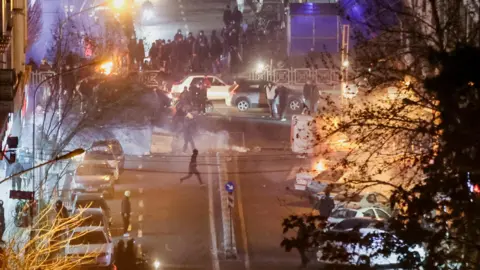
Ernest Hemingway once remarked that an authoritarian regime deteriorates gradually then suddenly, a notion that seems to resonate with the current climate in Iran. In recent weeks, protests have surged, fueled by a combination of anger over economic hardships and deep-rooted frustrations towards the government.
Significantly, the Islamic regime's capacity to respond has become a focal point, as protests have erupted following years of sanctions, particularly intensified after the failure of the 2015 nuclear deal. In December 2025, food prices skyrocketed by over 70%, further igniting public outrage.
While the regime experiences unprecedented pressure, including military setbacks, its survival is bolstered by unwavering support from security forces. The Iranian Revolutionary Guards Corps (IRGC), crucial to enforcing state control, has effectively quelled prior protests and remains a pivotal player in maintaining order.
The IRGC, operating alongside the Basij militia, forms a robust apparatus for suppression, instilling fear among civilians and swiftly responding to dissent. Witnesses of the violent crackdowns capture the chilling response of the regime, which has led to a significant reduction of protests to scattered groups chanting slogans.
Despite potential cracks in the regime, particularly through the discontent of the populace, the incumbent leadership appears resolute, navigating challenges with calculated moves. As such, Iran's supreme leader seeks to preserve systemic stability, responding both with military coercion and a willingness to resume negotiations with the US.
In essence, while protests may flutter, the cycle of resistance against authoritarian control is neither simple nor linear. The lessons from other nations, including Syria’s Assad and Tunisia’s Ben Ali, linger in the backdrop, illustrating the precarious nature of regime longevity amidst internal and external tumult.
As Iran's voice against oppression continues to echo, one can only ponder: is it merely a gradual decay, or are we on the brink of witnessing something more radical?